

with Spatial Intelligence
Unlock Walkable Hong Kong
with Spatial Intelligence
Analyse your
Walkable Zone and Nearby Facilities with 3D Spatial Data,
embark on your journey with
Diversified Route Planning.
What is a Walkable City?
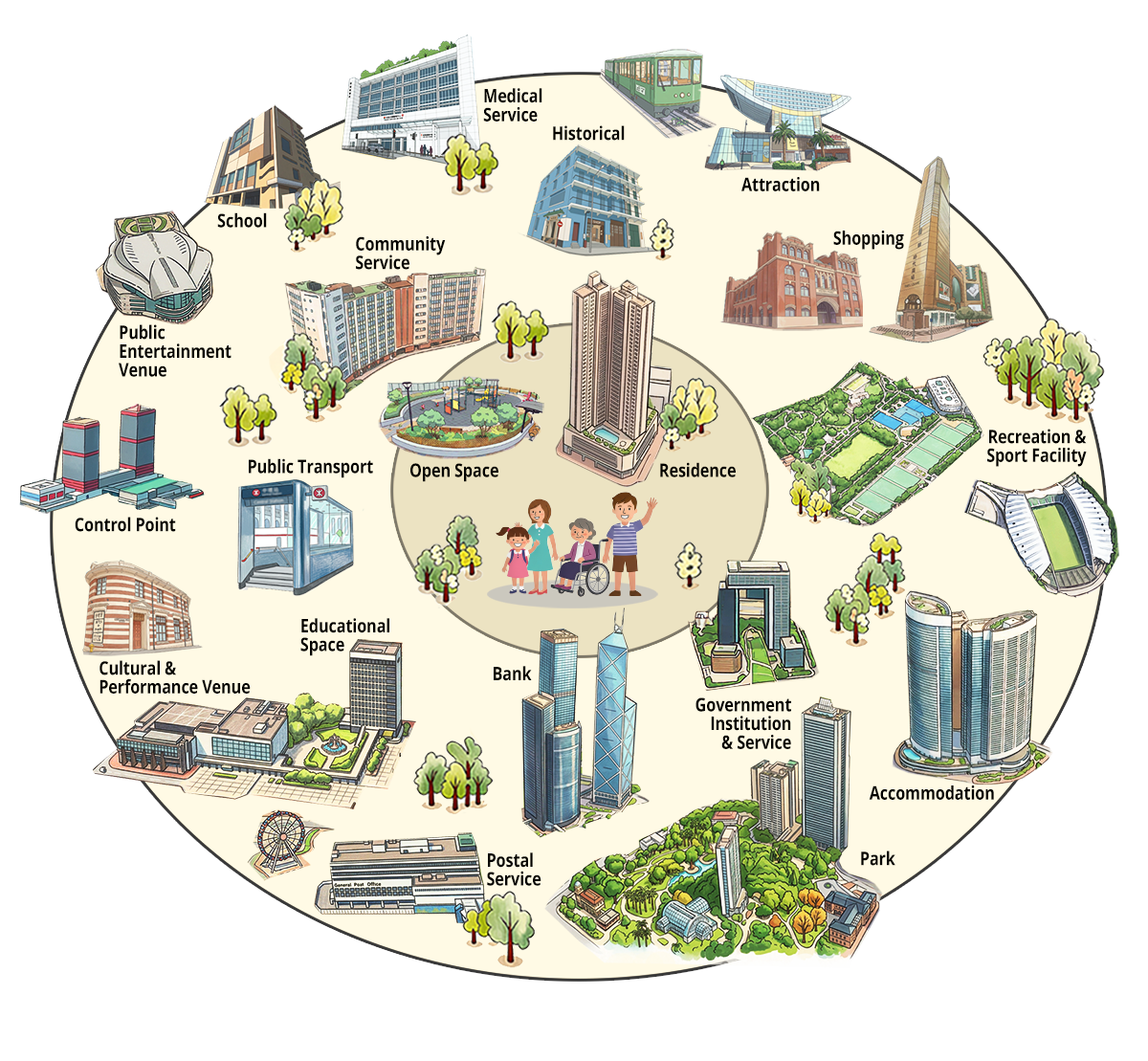
A Walkable City is an urban environment designed for people rather than cars, allowing residents to easily and safely access daily necessities, such as shops, schools, workplaces, and public transport, on foot (often within a 15-minute walk).
-
Achieve a sustainable and low-carbon living
-
Enhance community cohesion and local economy
-
Promote social equity and connectivity

Core Analytic Functions
Explore the 3 key spatial analysis tools in this Use Case.
Walkable Zone & Facilities Analysis
Create a walkable zone from a chosen location using time, distance or walking speed upon considering the walking conditions (e.g. slopes and stairs), and displays community facilities within the area.
Point-to-Point Routing
Derive ideal paths based on your selected starting point, mid points and ending point, providing the shortest, flat surface and barrier-free paths for considerations.
Multi-Stop Optimisation
Plan the best order to visit multiple facilities in shortest distance, providing the shortest, flat surface and barrier-free paths for consideration.
Powered by CSDI & GIS Technology
Use Open Spatial Data and Spatial
Analysis to produce insightful results.
Click the info box to learn more.
1. Prepare Data
Search and collect suitable open spatial datasets from the CSDI Portal.
2. Calculate Walkable Zone
By choosing the starting point, the tool will calculate the walkable zone by using 3D Pedestrian Network with the user-defined walking parameters.
3. Find Facilities
Search for community facilities within the walkable zone across the six categories.
4. Derive Routing Options
Calculate the feasible routing options based on the selected parameters for routing suggestions.
Spatial Data Inventory
Leveraging 200+ Datasets from the CSDI Portal to build the community facilities layers.
3D Pedestrian Network
Provided by Lands Department. This is the backbone of walkable zone calculation and routing analysis, offering a 3D topologically connected network of publicly accessible area in the built-up areas, as well as parts of outlying islands, villages, and country parks in Hong Kong.
Our Six Key Categories of Daily Necessities
Conveniently located facilities
essential to our daily lives, categorised as:
Living, Health Care & Social Welfare, Education,
Entertainment, Transportation, and Tourism.
Living
Daily essentials and urban conveniences, ranging from dining and banking to public utilities and government services.
Health Care & Social Welfare
Vital community support systems, featuring medical clinics, elderly care, youth services, and rehabilitation centers.
Education
Major academic institutions in Hong Kong, covering kindergartens, schools, universities, and special education facilities.
Entertainment
Recreational and cultural hubs, including parks, sports centres, performance venues, and ecological reserves.
Transportation
Critical mobility nodes connecting the city, including public transport stops, parking, and petrol filling stations.
Tourism
Key points of interest for visitors, encompassing historical landmarks, major attractions, and accommodation options.
Acknowledgement




- Common Spatial Data Infrastructure (CSDI) Use Cases (the "Use Cases") is a web-based application provided by the Lands Department (the "LandsD") of the Government of the Hong Kong Special Administrative Region (the "Government") to the public.
- In these Terms and Conditions of Use of the Use Cases ("Terms of Use"), "Data" means the data and all
contents provided by the Government and other organisations to the public on the Use Cases. For the
avoidance of doubt, "Data" include all data, digital maps, text, graphics, drawings, diagrams,
photographs, compilation of data, and other materials of the Use Cases.
Use of Data on the Use Cases - You are allowed to browse, download, distribute, reproduce, hyperlink to, and print the Data for both
commercial and non-commercial purposes on a free-of-charge basis on condition that:
- you shall comply with the Terms of Use;
- you shall identify clearly the source of the Data and acknowledge the Government ownership of the intellectual property rights in the Data and in all copies thereof including but not limited to paper copies, digital copies and copies placed on other websites;
- you shall indemnify the Government against any allegations or claims of infringement of the rights of any person and all costs, losses, damages and liabilities incurred by the Government, which in any case arise directly or indirectly in relation to your use, reproduction and/or distribution of the Data;
- you shall also give proper attribution to the Government and the "LandsD's CSDI Use Cases (https://usecases.csdi.geodata.gov.hk/)".
- In paragraph 3, "commercial purposes" include, without limitation, the following:
- an offer to supply goods, services, facilities, land or an interest in land;
- an offer to provide a business opportunity or an investment opportunity;
- an advertisement or promotion of goods, services, facilities, land or an interest in land;
- an advertisement or promotion of a business opportunity or an investment opportunity;
- an advertisement or promotion of a supplier, or a prospective supplier, of goods, services, facilities, land or an interest in land; and
- an advertisement or promotion of a provider, or a prospective provider, of a business opportunity or an investment opportunity, in the course of or in the furtherance of any business.
Disclaimer and Limitation of Liability - No statement, representation or warranty of any kind (whether express or implied) is given by the Government or the relevant organisations in relation to the Data (including the accuracy, completeness, non-infringement, reliability, security, timeliness and appropriateness of the Data for use in any particular circumstances). The Government or the relevant organisations shall not be liable for any errors, omissions, misstatements or misrepresentations (express or implied), concerning any Data, and shall not have or accept any liability, obligation or responsibility whatsoever for any loss, destruction or damage (including without limitation consequential loss, destruction or damage) howsoever arising from or in respect of any use or misuse of or reliance on the Data, or any inability to use the Data.
- In consideration of the Government and other organisations providing the Data on the Use Cases, by using the Use Cases, you accept unconditionally the Terms of Use. If you do not agree, do not use the Use Cases. The Terms of Use may be revised and/or amended from time to time by the Government or the relevant organisations without prior notice to any person. Please check the Terms of Use regularly for any revisions and/or amendments which may be made.
- The Government shall not be liable for any loss, destruction or damage howsoever arising out of or in relation to any transmission from you to the Government or vice versa over the Internet.
- The Government shall not be responsible for any loss or damage whatsoever arising out of or in connection with the Data. The Government reserves the right to revise, omit, edit or suspend the provision of the Data at any time in its absolute discretion without giving any reason or prior notice to any person (including you).
- The Government does not undertake to provide any updated version of the Data and reserves the right to
suspend the provision of the Data and Service at any time.
Linked Information and other Third-Party Websites - The Use Cases may provide or assist in providing links to third-party websites. The links are produced
solely as a convenience to users of the Use Cases. Provision of, or assistance in providing, any links at
the Use Cases to any third-party website does not give rise to any statement, representation or warranty,
express or implied, that the Government agrees with, approves, recommends or endorses the contents of any
such third-party websites. The provision of any links to third-party websites shall not constitute any
form of co-operation or affiliation with the Government of any such third parties or external websites.
The Government shall not have or accept any liability, obligation or responsibility whatsoever for any
loss, destruction or damage (including without limitation consequential loss, destruction or damage)
howsoever arising from or in respect of your use or misuse of or reliance on, or inability to use such
links to any third-party website or your use or reliance on the contents of any such third-party websites.
You should refer to the terms and conditions of each such third-party website when using such website.
Intellectual Property Rights - Unless otherwise indicated, the Government is the owner of the intellectual property rights in all contents available on the Use Cases, including but not limited to all Data.
- If there is any inconsistency or ambiguity between the English version and the Chinese version, the English version shall prevail.